
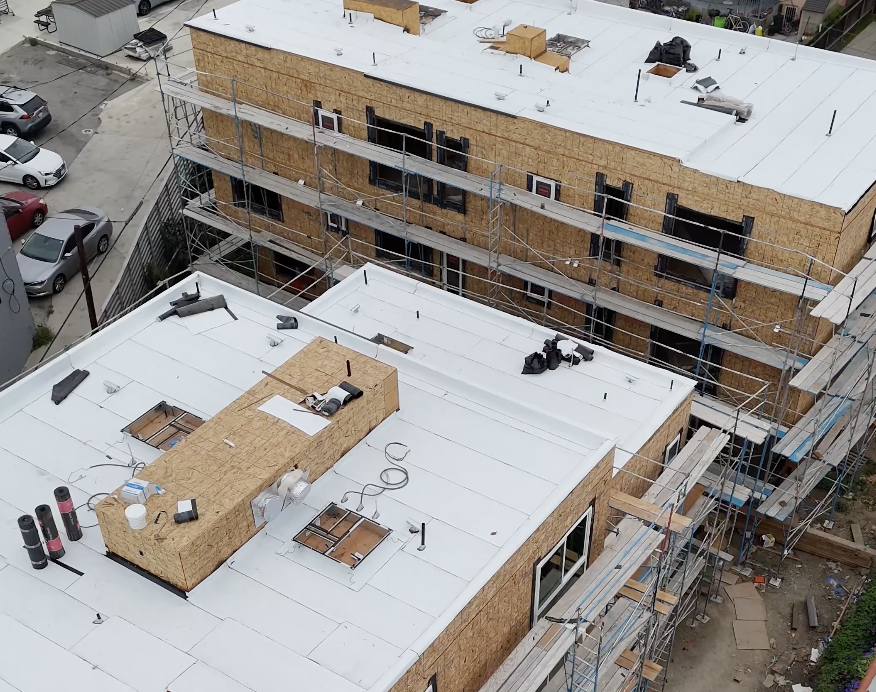
TPO Roofing Installation on Multi-Unit Building in Los Angeles
This project involved the installation of a TPO roofing system on a multi-unit residential building in Los Angeles. Flat roofs in areas such as Bel Air, Pacific Palisades, and Beverly Hills require durable waterproofing systems that can handle UV exposure, structural movement, and long-term performance.
This project was completed in Los Angeles, with conditions similar to Bel Air, where flat roof systems must perform under constant sun exposure, drainage challenges, and ongoing construction activity.
The objective was to install a clean, continuous waterproofing system across multiple roof sections while coordinating with ongoing framing and construction work.
For this reason, we installed a TPO roofing system using high-quality materials, including GAF TPO membranes.
Project Overview
Location: Los Angeles
Project Type: TPO roofing installation
Structure: Multi-unit residential building under construction
Roof Type: Flat / low-slope wood-framed roof (plywood substrate)
Primary System: TPO single-ply roofing membrane
Material Used: TPO membrane system including GAF components
The Challenge
This project presented several real-world construction challenges.
For example:
• active construction environment with multiple trades on site
• plywood substrate requiring proper preparation
• multiple roof penetrations and openings
• transitions between different roof elevations
• coordination with future installations (HVAC, vents, skylights)
Because the structure was still under construction, the waterproofing system needed to be installed carefully to avoid damage and ensure long-term performance. Therefore, sequencing and detailing were critical.
TPO Roofing Installation Process
The installation began with preparation of the plywood roof deck to ensure proper adhesion and performance.
Installation included:
• inspection and preparation of plywood substrate
• layout and positioning of TPO membrane sheets
• heat-welding seams to create a continuous waterproof layer
• sealing of all penetrations and vertical transitions
• reinforcing edges, corners, and terminations
In addition, special attention was given to seam welding consistency, since this directly affects the integrity of the waterproofing system.
Critical Roofing Details
Based on the project conditions, several key areas required precision:
• roof penetrations and pipe flashings
• skylight and opening transitions
• parapet and edge terminations
• elevation changes between roof sections
• drainage direction and water flow control
As a result, proper detailing ensured full continuity across all roof areas.
Results
The completed TPO roofing system provides a clean, uniform, and fully sealed waterproofing layer across the structure.
Key outcomes included:
• continuous waterproof membrane across multiple roof sections
• strong, heat-welded seams for long-term durability
• improved resistance to UV exposure and heat
• readiness for future construction phases without compromising waterproofing
As a result, the system is designed to perform reliably under Los Angeles climate conditions.
Why TPO Roofing Works for Projects Like This
TPO roofing is well suited for multi-unit construction projects because it provides:
• fast and efficient installation
• strong waterproof seams through heat welding
• flexibility for structural movement
• resistance to UV and weather exposure
Therefore, it is commonly used for flat roofs across Los Angeles, including Bel Air and surrounding areas.
TPO Roofing Services in Los Angeles
Surfacing and Waterproofing provides roofing services throughout:
Los Angeles
Bel Air
Pacific Palisades
Beverly Hills
West Hollywood
Malibu
Services include:
• TPO roof installation
• flat roof waterproofing
• roof replacement
• commercial and multi-unit roofing systems
Request a Roofing Consultation
If you are planning a TPO roofing project in Los Angeles, Bel Air, or Beverly Hills, we can design a system tailored to your building.
Contact Surfacing and Waterproofing (323) 508-4033 for guidance, or send plans and specifications.